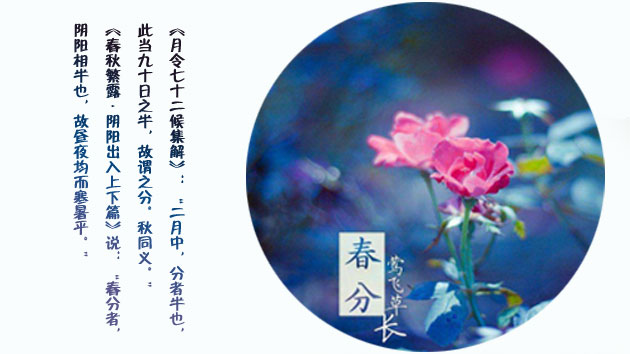
The Spring Equinox (春分), also known as the “Ascending Equinox,” and historically referred to as Rizhong, Riyefen, or the “Mid-Spring Month,” is the fourth of the 24 solar terms. It occurs when the handle of the Big Dipper points to the celestial direction of Mao and the sun reaches a celestial longitude of 0°, typically falling between March 19 and 22. The term “Fen” (division) carries two meanings: first, the equal division of the season, as it marks the midpoint between the Beginning of Spring (Lichun) and the Beginning of Summer (Lixia); second, the equal division of day and night. On this day, the sun shines directly on the equator, resulting in exactly 12 hours of daylight and darkness worldwide. Astronomically, it marks a turning point as the sun’s direct rays migrate northward, making days longer than nights in the Northern Hemisphere. Climatically, this period is characterized by warming temperatures, abundant sunshine, and plentiful rainfall. Across China—excluding high-altitude or northernmost regions—nature awakens, and overwintering crops enter their vigorous spring growth phase. Tracing back to the Spring and Autumn period, the concept of “Mid-Spring” was already established, with the full 24 solar terms formalized by the Qin and Han dynasties. References to the Spring Equinox appear as early as the Rites of Zhou, with further descriptions found in the Book of Documents and the Classic of Poetry. Beyond its astronomical weight, it signals the height of the sowing season, profoundly influencing agriculture and traditional customs such as spring sacrifices, kite flying, and the ritual of balancing eggs.
Phenological Phenomena
The Arrival of the Dark Birds (Xuan Niao Zhi)
The “Dark Bird” refers to the swallow. Gao You (a Han dynasty scholar) noted: “They arrive at the Spring Equinox and depart at the Autumn Equinox.” The first pentad (five-day period) of the Spring Equinox, “The Arrival of the Dark Birds,” describes this seasonal migration. Their return signals the height of spring, where the wilderness teems with sprouting herbs and the landscape is painted with the vibrant reds of peach blossoms and the pure whites of plum flowers.
Thunder Begins to Resound (Lei Nai Fa Sheng)
Thunder is the result of the “thinning” and clashing of Yin and Yang energies. At this stage, the “Four Yang” energies are flourishing, yet residual Yin persists; their collision produces sound. The word Nai (乃), according to the Yunhui dictionary, mimics the difficulty of pent-up energy breaking free. Commentaries suggest that Fa (发) means “to emerge” or “to release.”
First Lightning (Shi Dian)
Lightning is the manifestation of solar light. As the “Four Yang” energies grow vigorously and the Earth’s Qi is released, light is generated. Thus, the Lijie (Explanation of the Calendar) states: “Both sound and light are Yang.” The I Ching (Book of Changes) says: “Thunder and lightning combine to create brilliance.” The Gongyang Zhuan further notes: “Lightning is the light of thunder.” This confirms the nature of lightning, refuting Master Xu’s claim that “thunder is Yang while lightning is Yin.” Indeed, even in midsummer when thunder is absent, lightning can still occur.
Traditional Customs
In ancient times, the Spring Equinox was also known as Rizhong (Mid-day), Riye-fen (Equal Day and Night), or Zhongchun-zhi-yue (The Peak Month of Spring). On this day, it is a popular Chinese folk tradition for women and children to fly kites. A common folk saying also suggests, “Once you’ve tasted shepherd’s purse, all other vegetables lose their flavor.” In the Lingnan region, the custom of eating “spring vegetables” prevails, while another widespread saying goes, “As the Spring Equinox arrives, eggs become lively.” Every year, millions of people worldwide participate in the “egg-standing” challenge. Other enduring traditions include spring outings and sacrificial rituals, reflecting the Chinese people’s profound reverence and unique sentiment for this solar term.
Egg Standing
“Spring Equinox arrives, eggs become lively.” On this particular day, tens of millions of people globally attempt to balance eggs upright. While it remains unclear how this “Chinese custom” evolved into a “global game,” its appeal lies in its simplicity and the sheer fun of the challenge.
Sacrificial Rituals
According to the Book of Rites, the tradition of “worshipping the sun at the altar” has been passed down through generations. The Temple of the Sun (Ritan), located east of Ritan Road outside Chaoyangmen in Beijing, is also known as the Altar of the Rising Sun. It was the sacred site where emperors of the Ming and Qing dynasties performed sacrifices to the “Great Luminary” (the Sun) on the day of the Spring Equinox.
Eating Spring Vegetables (Chincai)
As the name suggests, Spring Vegetables refer to the fresh greens of the season. In the Lingnan region, it is a custom to eat these greens during the Spring Equinox. The specific variety is a type of wild amaranth, locally known as “Spring Green Mugwort.” On this day, villagers head to the fields to forage for these vibrant, palm-sized tender shoots. The gathered greens are typically simmered with sliced fish to create a light soup called “Spring Soup.” A popular folk ditty goes: “Drink the Spring Soup to cleanse the soul and body; may the whole family stay safe and healthy.” In Yangjiang, women also gather various floral leaves to grind into powder, mixing them with rice flour to make noodles, which are believed to clear internal heat and detoxify the body.
Sending the Spring Ox (Song Chunniu)
As the Spring Equinox arrives, “Spring Ox Pictures” are distributed. These are red or yellow sheets of paper printed with the lunar calendar’s solar terms and illustrations of farmers plowing the fields. The distributors are usually skilled folk singers with a gift for gab. They recite rhythmic verses about spring plowing and auspicious seasonal timing. Upon entering a home, they improvise witty rhymes until the delighted host offers a small tip. This practice is known as “Spring Chanting,” and these performers are affectionately called “Spring Officers.”
Gluing the Sparrow’s Beak (Zhan Quezi Zui)
On this day, farming families prepare Tangyuan (glutinous rice balls). Besides eating them, they boil twenty or thirty unfilled rice balls, skewer them on thin bamboo sticks, and place them along the edges of the fields. This ritual is called “Gluing the Sparrow’s Beak,” a symbolic gesture to prevent birds from pecking at the crops and damaging the harvest.
Spring Outings and Kite Flying (Taqing)
Following the Spring Equinox, people venture outdoors for “Spring Outings” (Taqing), with kite flying being a highlight. In ancient times, it was also customary for people of all ages to wear flowers in their hair and enjoy wine. Kites were originally called Yao or Yuan, named after birds of prey like hawks and kites (the bird). Early kites were crafted from silk or paper into the shapes of these birds, hence the names “Paper Hawk” or “Paper Kite.” Over time, various shapes emerged, with the swallow-shaped kite becoming a quintessential symbol of spring.
Daily Wellness and Self-Care
During the Spring Equinox, Yin and Yang are perfectly balanced in nature. Therefore, one’s daily diet should follow the principle of balancing Yin and Yang to maintain the body’s harmony and stability. Additionally, as the climate becomes ideal for the breeding and spread of bacteria, it is crucial to ventilate rooms frequently by opening doors and windows. Growing indoor plants can also improve air quality and increase negative ion concentrations, which greatly benefits both physical health and mental well-being.
The dietary philosophy of the Spring Equinox emphasizes “harmonizing Yin and Yang—supplementing what is lacking and purging what is excessive.” Consuming an abundance of fruits and vegetables at this time helps replenish the vitamins and minerals depleted during winter. According to the Compendium of Materia Medica, Mugwort (Ai Ye) is warm in nature and bitter in taste; it is non-toxic and clears the twelve meridians. It possesses the power to restore Yang, regulate Qi and blood, expel dampness and cold, and stop bleeding. It is also a staple in moxibustion. Furthermore, this is the prime season for Yellow Sand Clams. In Guangzhou, these clams are typically stir-fried with Chinese chives, resulting in a dish that is exceptionally crispy, tender, and fragrant.