02 Another Universe
What kind of deities would inhabit this universe? The people of Sanxingdui believed that their ancestors were undoubtedly among them.
(Excerpted from Records of the States South of Mount Hua: Annals of Shu)
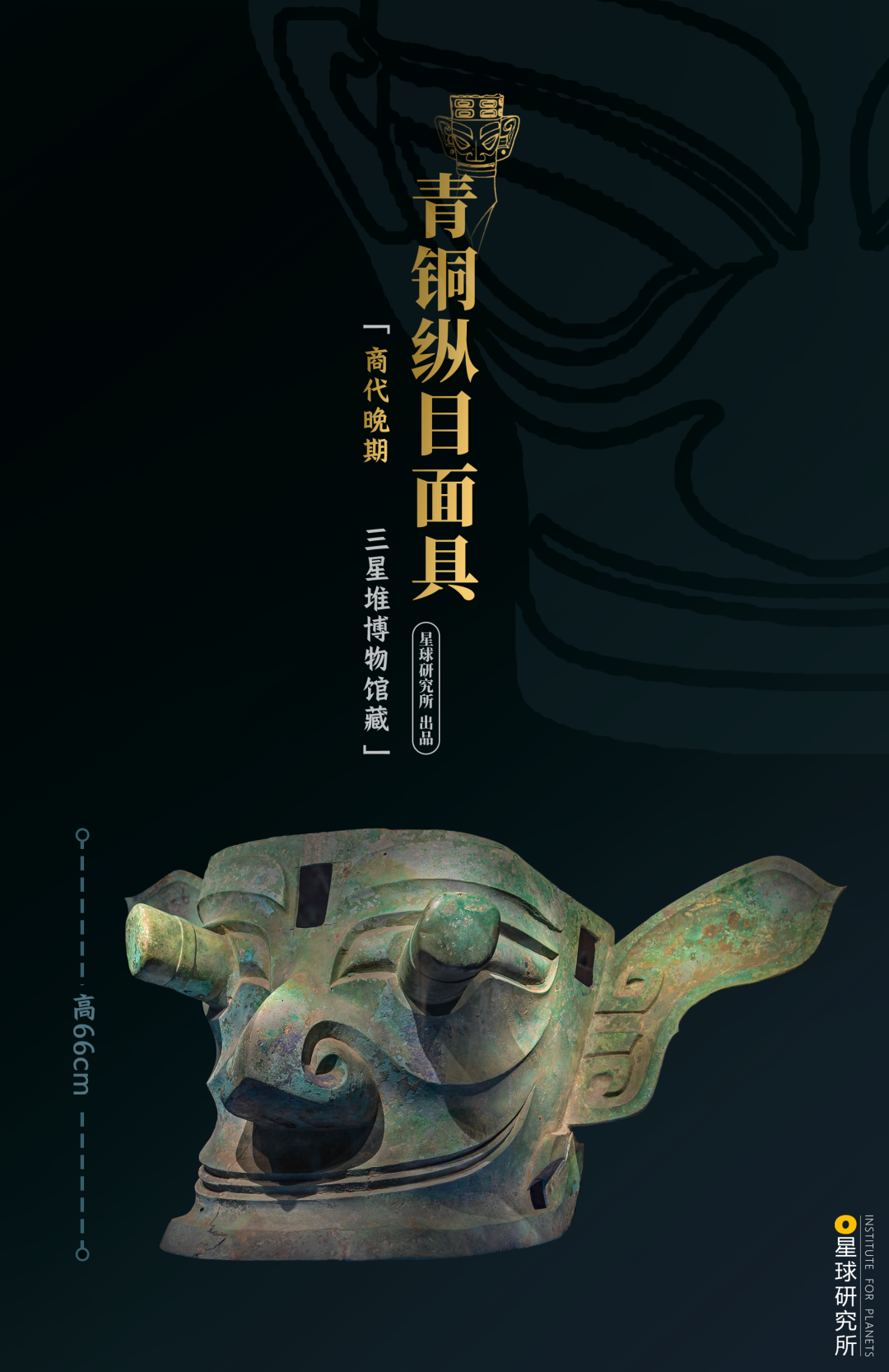
“There was Cancong, the Marquis of Shu; his eyes were vertical, and he was the first to claim the title of King.” Cancong—legend holds that he was the founder of the ancient Kingdom of Shu. It was he who led his clan to the lands of Sichuan, and he who taught the people the arts of sericulture and silk reeling. The people of Sanxingdui revered him as a deity; naturally, his distinctive protruding eyes came to be regarded as a defining characteristic of the divine.
(The protruding eyes on the mask likely serve as a visual representation of Cancong’s “vertical eyes,” symbolizing the ancestor worship practiced by the people of Sanxingdui. Photography: @Tang Yuxing; Graphics: @Feng Yizhuo / Planet Institute)
The mysterious and unfathomable wonders of the natural world also possess their own inherent divinity.
The ancient land of Shu is encircled by mountains and rivers; towering, formidable peaks pierce the clouds. In the imagination of the Sanxingdui people, this realm was the dwelling place of spirits—a gateway leading directly to the celestial heavens.
(Some scholars hypothesize that the mountains worshipped by the people of Sanxingdui were the Min Mountains. Photography: @Zhang Yan; Graphics: @Feng Yizhuo / Planet Institute)
Perhaps due to the hardships imposed by the region’s humid and rainy climate,
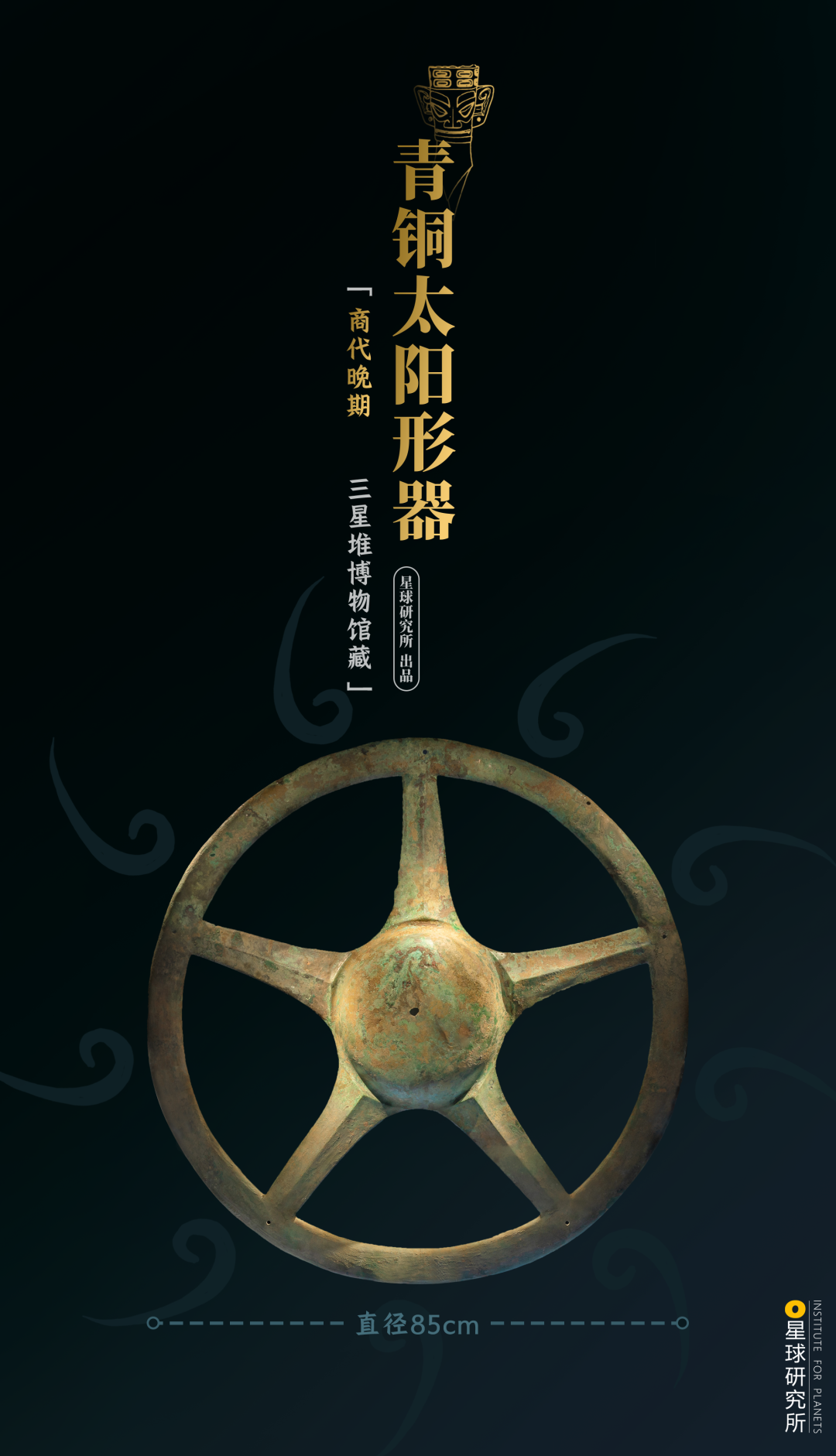
the power of the Sun became an object of profound reverence among the people of Sanxingdui.
(Sanxingdui Sun-shaped Artifact. Photography: @Tang Yuxing; Graphics: @Feng Yizhuo / Planet Institute)
 “Sanxingdui”
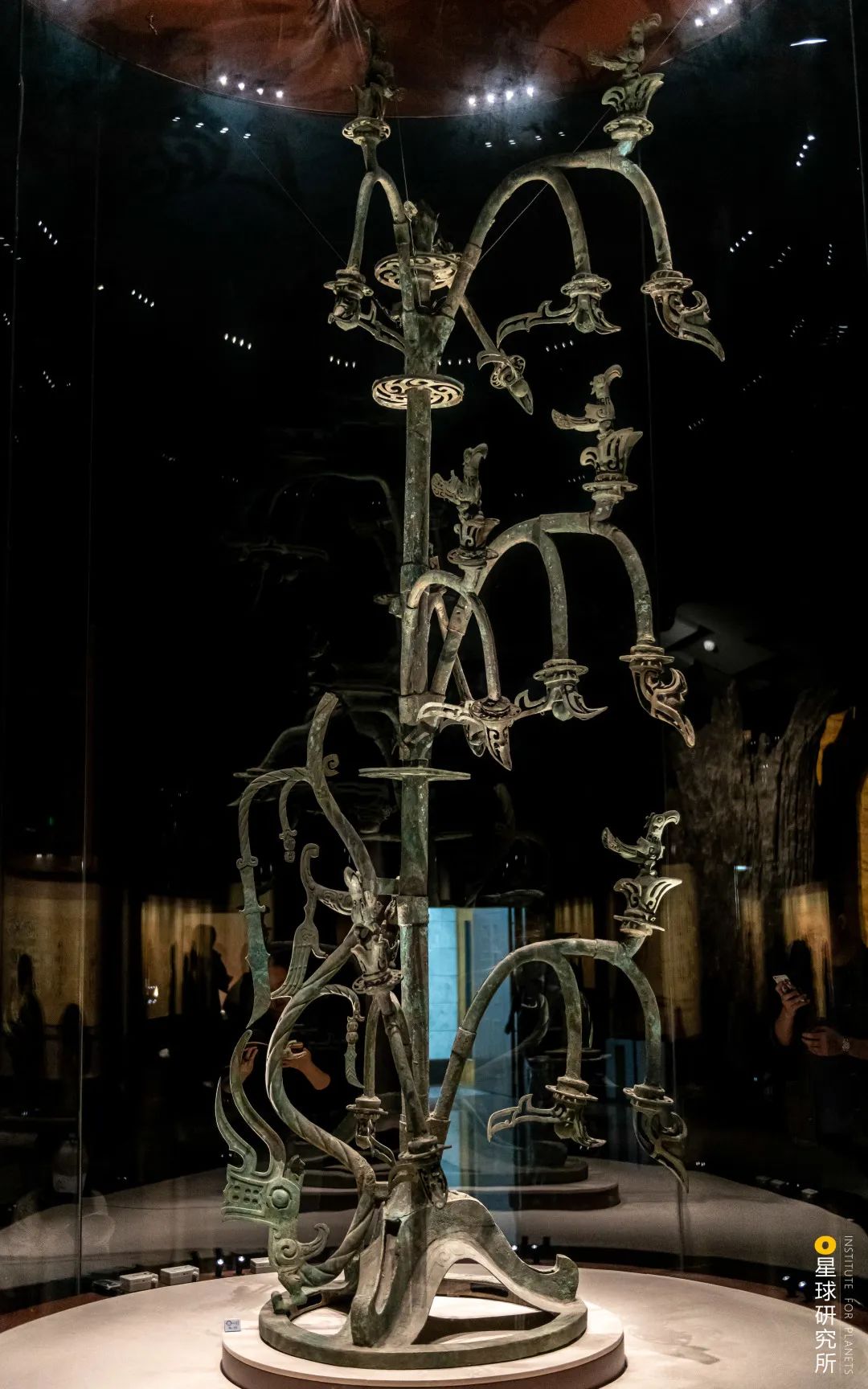
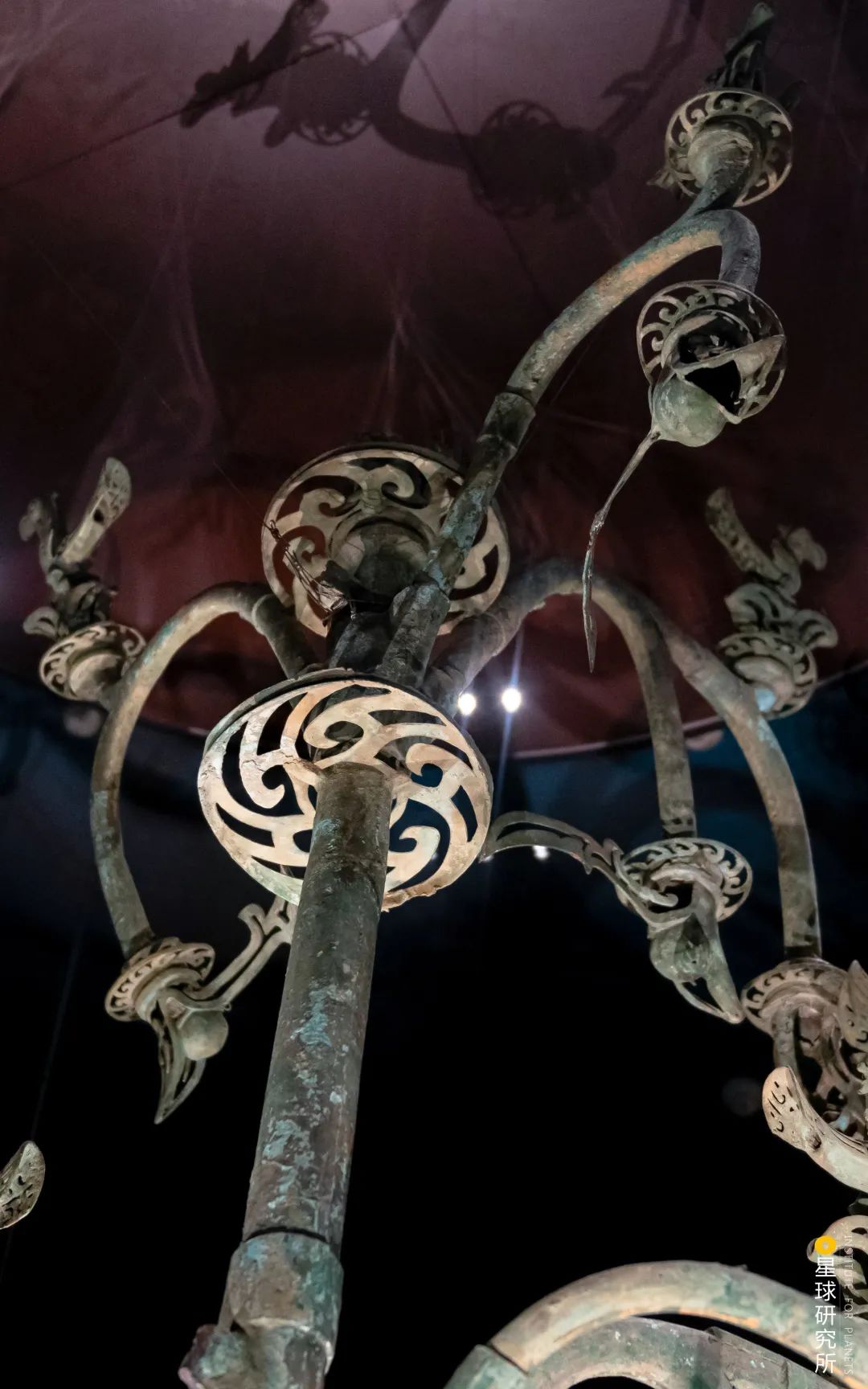
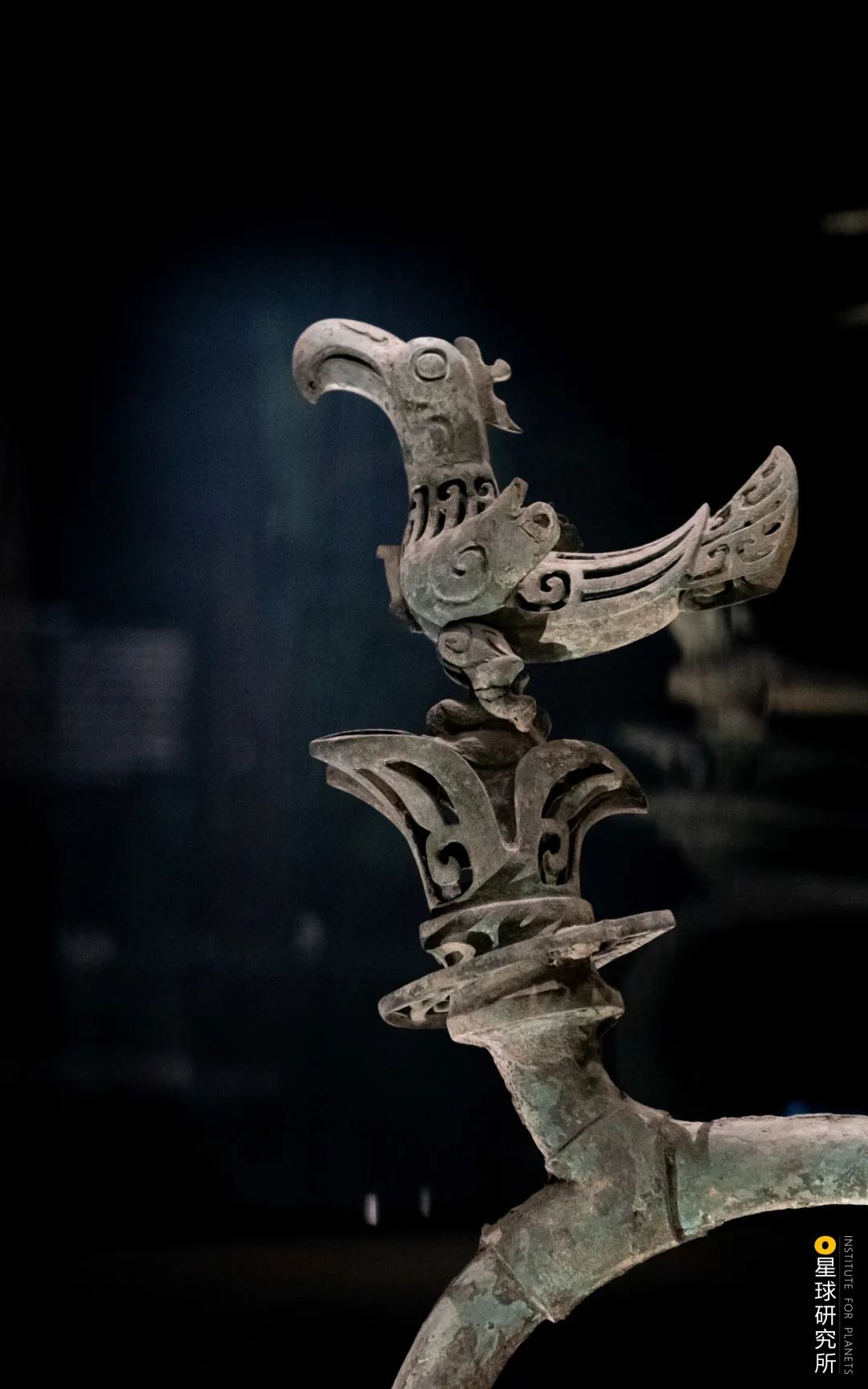
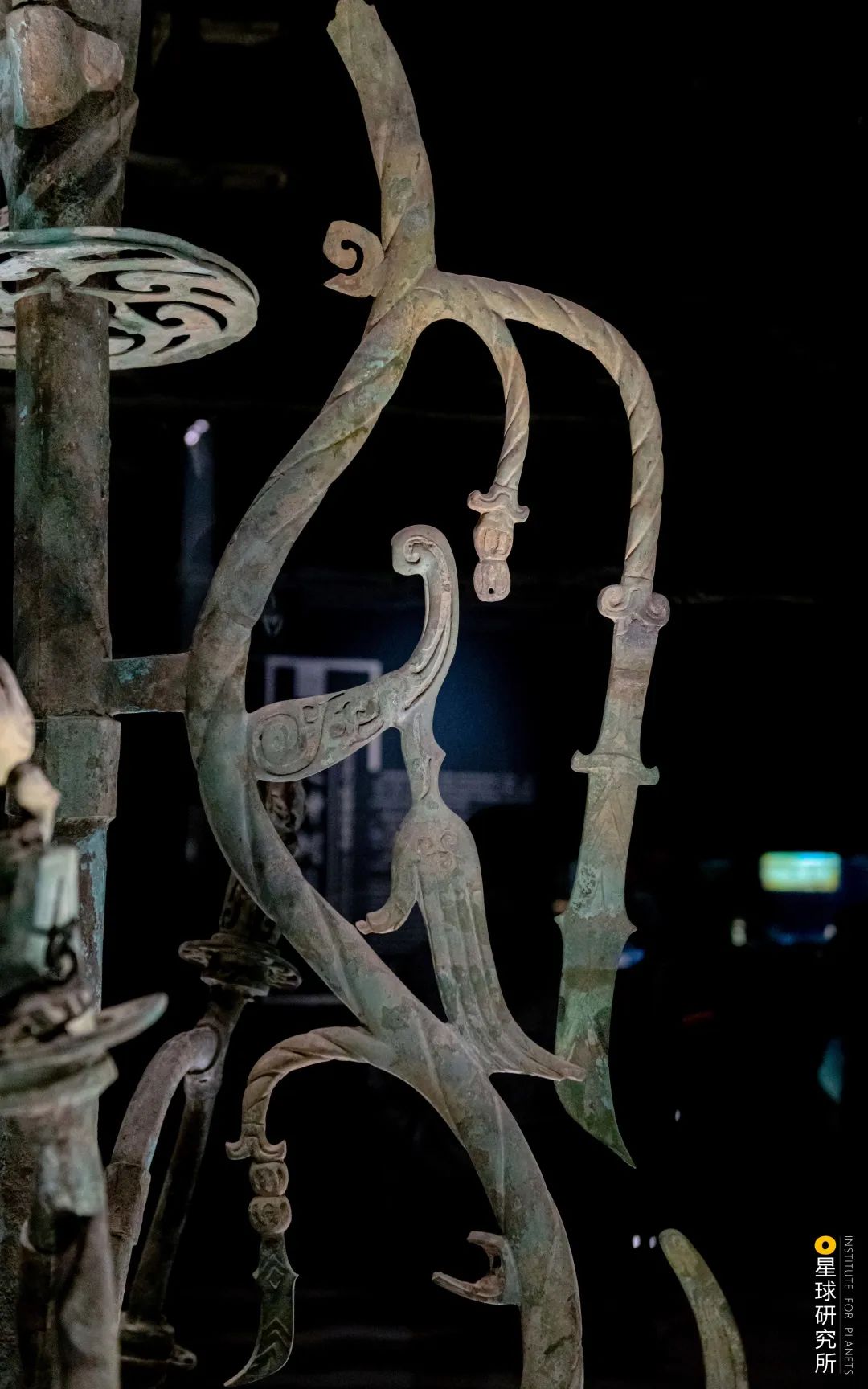
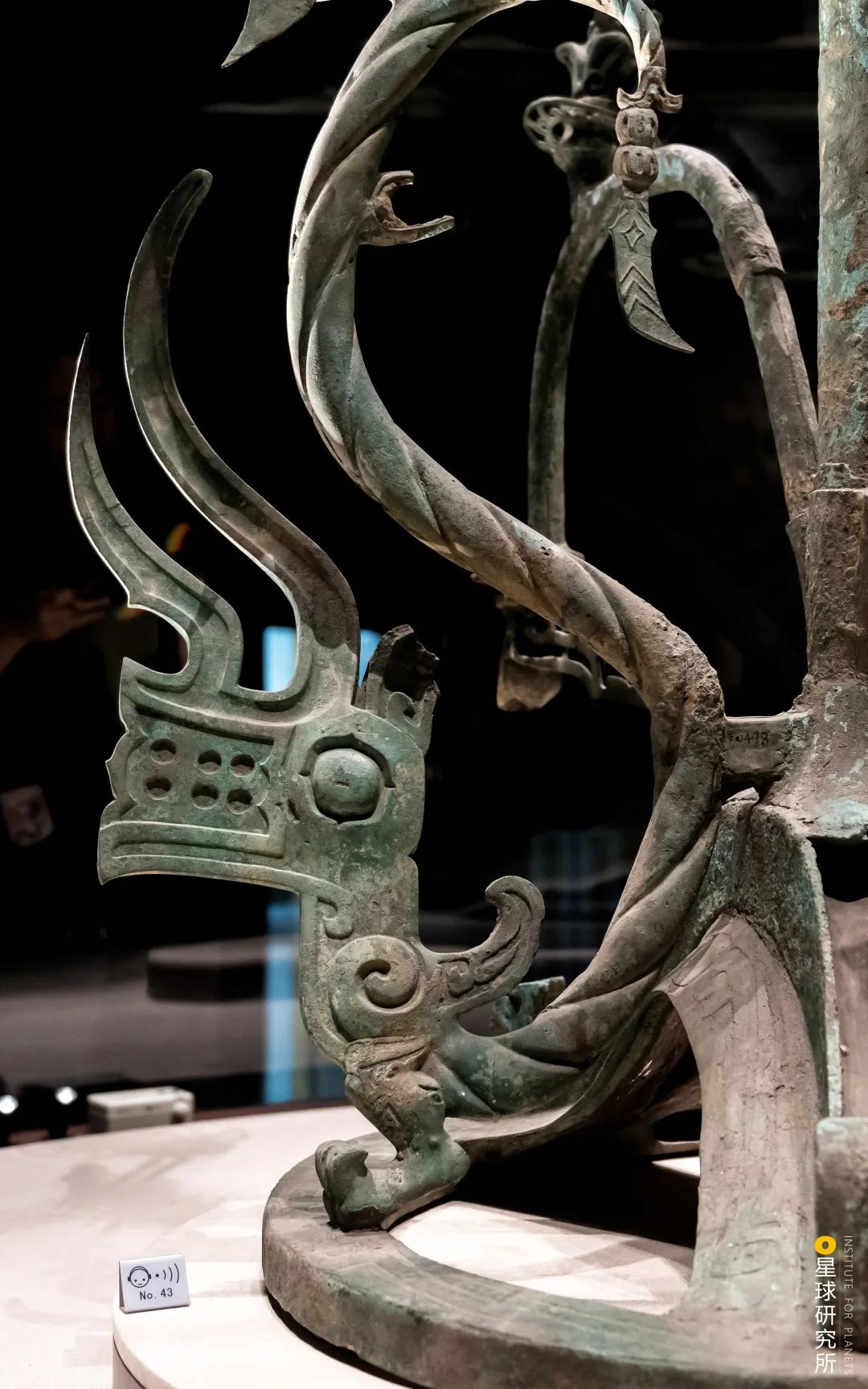
They crafted a bronze sacred tree, upon whose branches perched ten divine birds; these birds represented the ten suns of the heavens, taking turns to “stand watch” and illuminate the ancient land of Shu.
(Please admire the exquisite details of the Bronze Sacred Tree. Photography by @Bao Haolin)
 “Sanxingdui”
The people of Sanxingdui appear to have held a special reverence for birds—perhaps, in their imagination, the deities themselves took on avian forms.
(These figures—depicting a human head atop a bird’s body—are found adorning the apexes of small bronze sacred trees and altars at Sanxingdui; they may symbolize the “Central Deity” or the Sun God. Photography: @Liuyedao; Graphics: @Feng Yizhuo / Planet Institute)
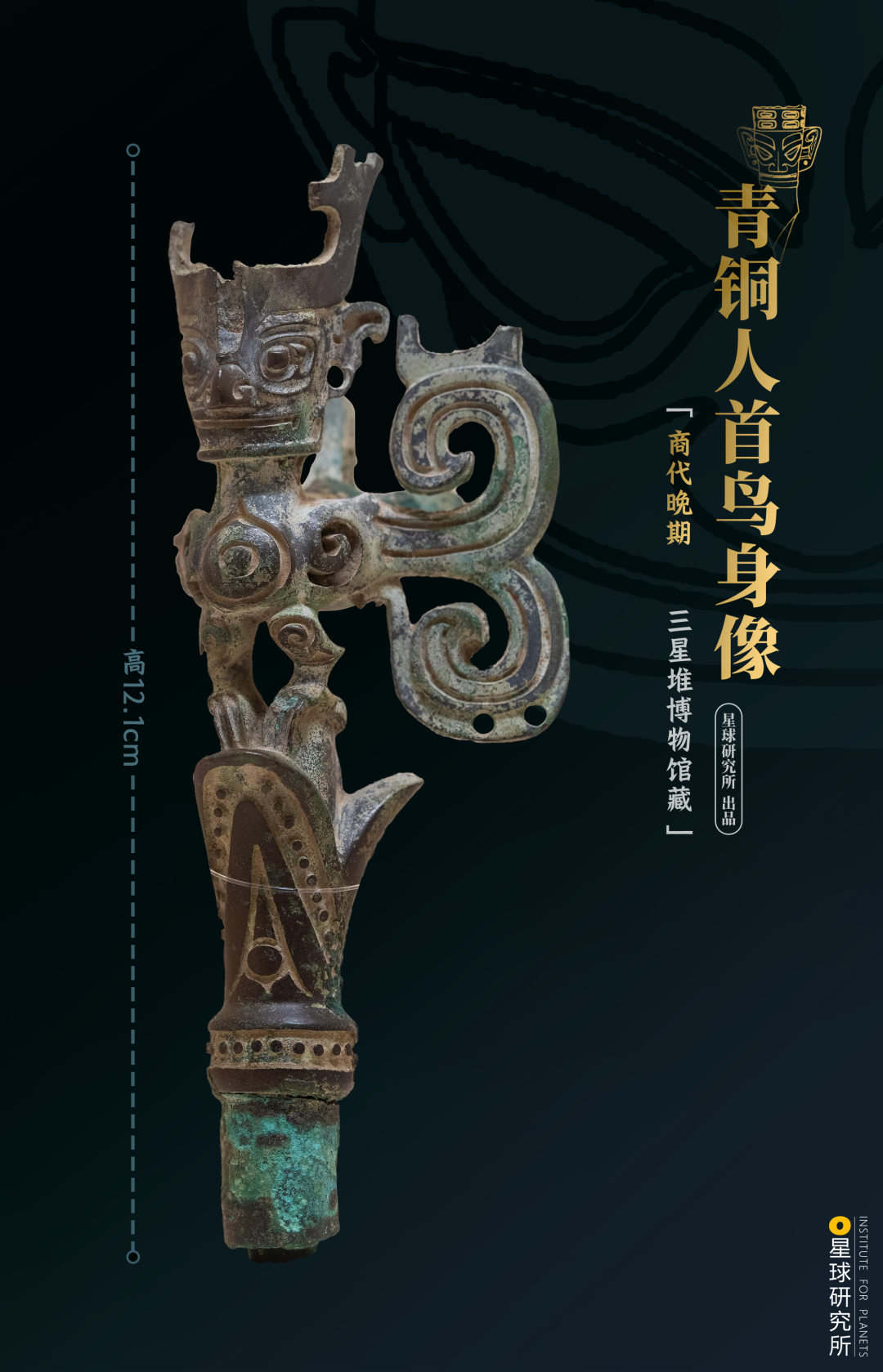
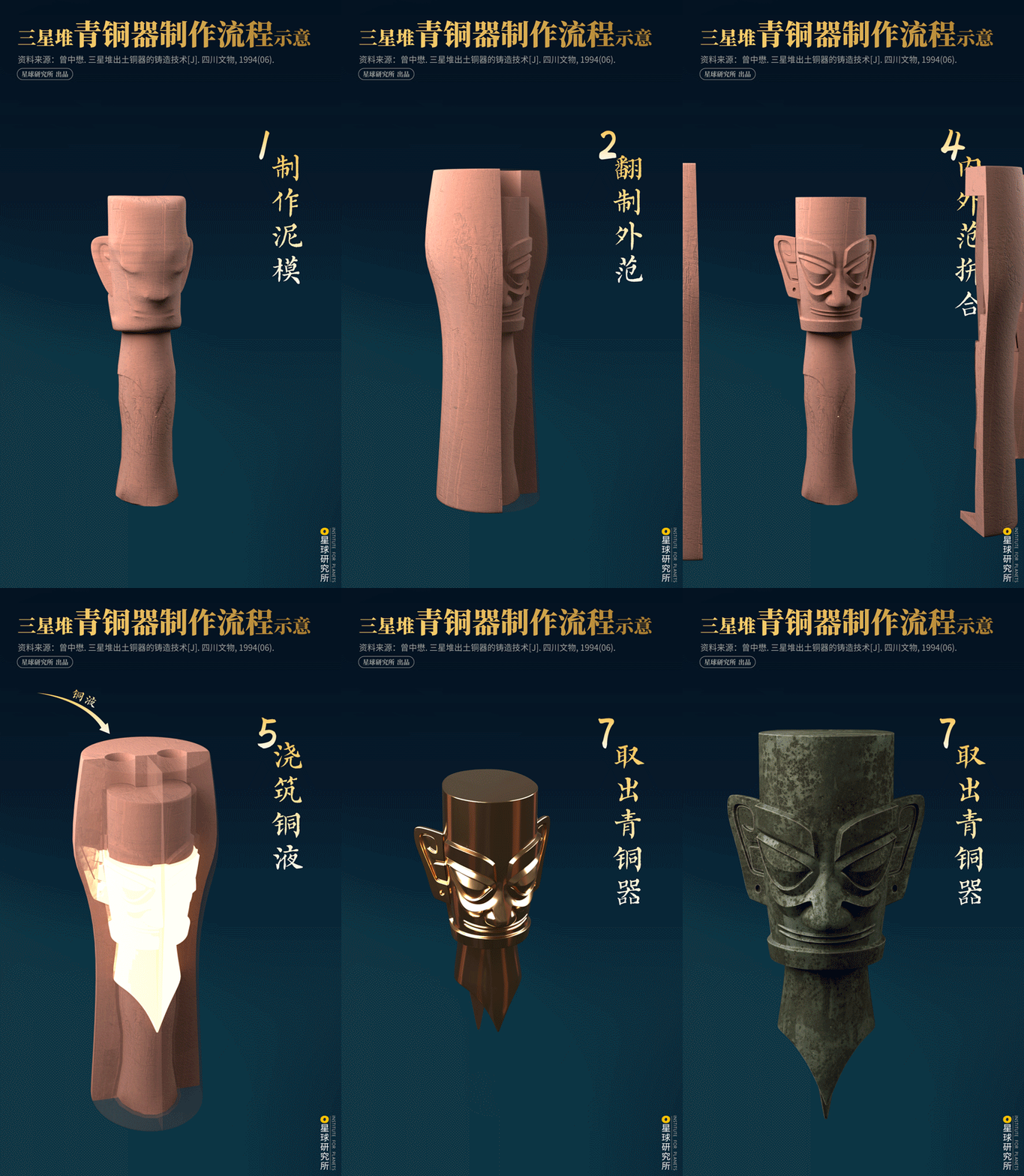
This universe is so fantastical and vibrant—so, how might one reveal it to the world? The other universe—the realm where the gods reside—had to be crafted from the most precious materials. Precious bronze, in the hands of artisans within the foundry workshops, was cast into the very likeness of the deities.
(For certain artifacts with intricate designs, individual components would first be cast separately and then joined together; Illustration by Feng Yizhuo / Planet Institute)
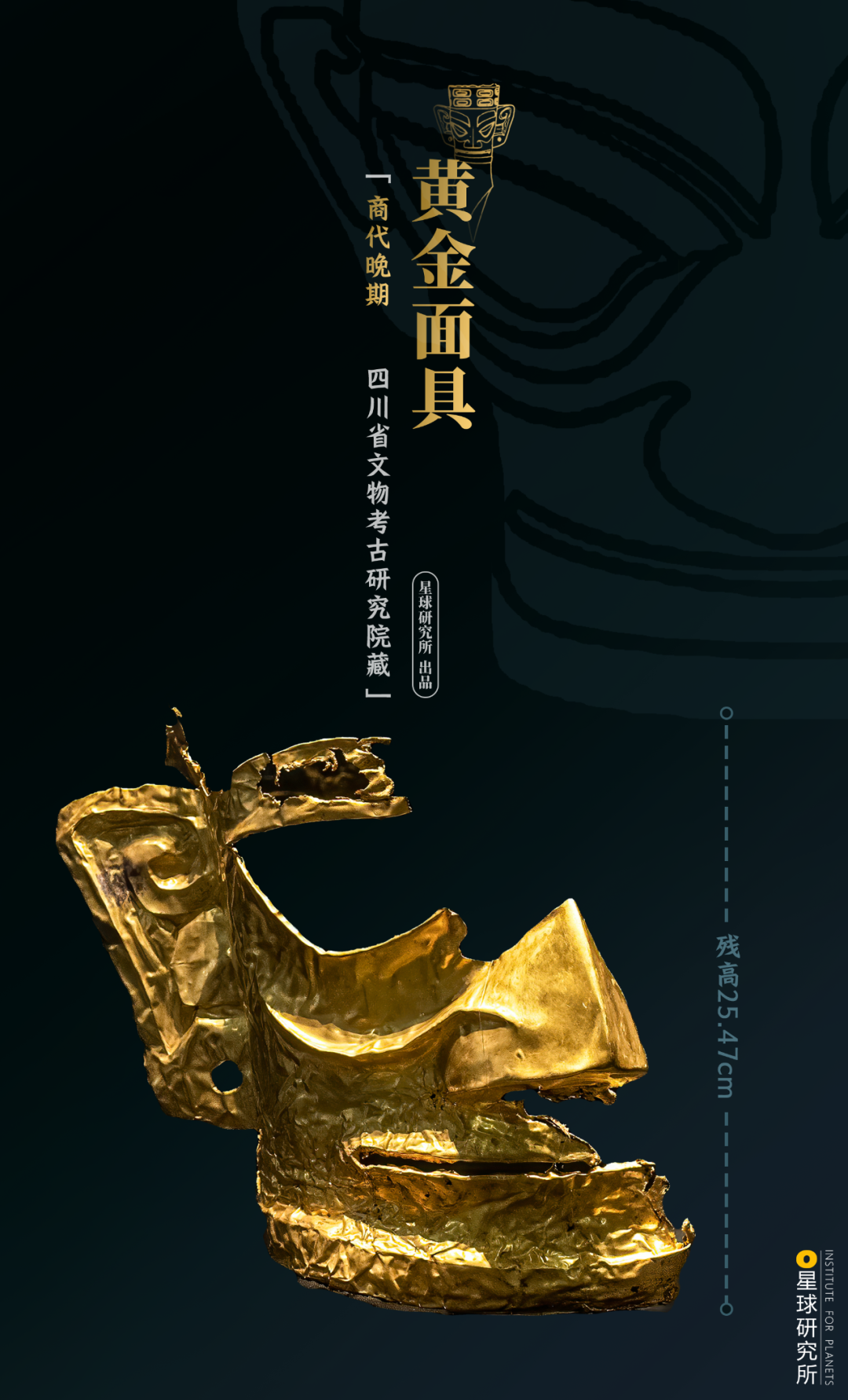
Rare gold was forged into “masks” for the gods—the most noble and exalted of divine countenances.
(The gold mask unearthed from Pit No. 5 at Sanxingdui is currently the largest gold mask discovered in China dating back to the Shang and Zhou dynasties; Photography by Zhang Lei, Illustration by Feng Yizhuo / Planet Institute)
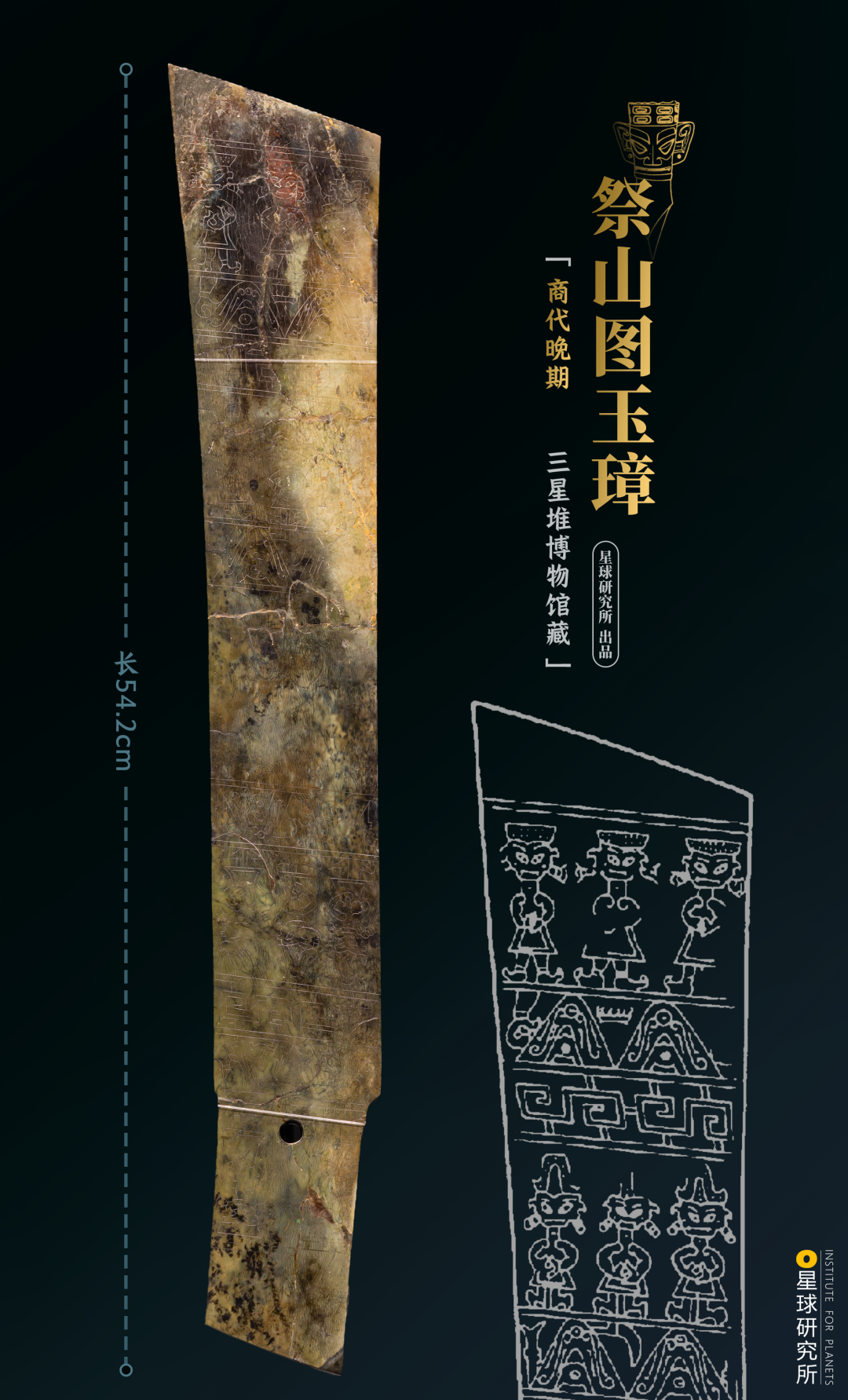
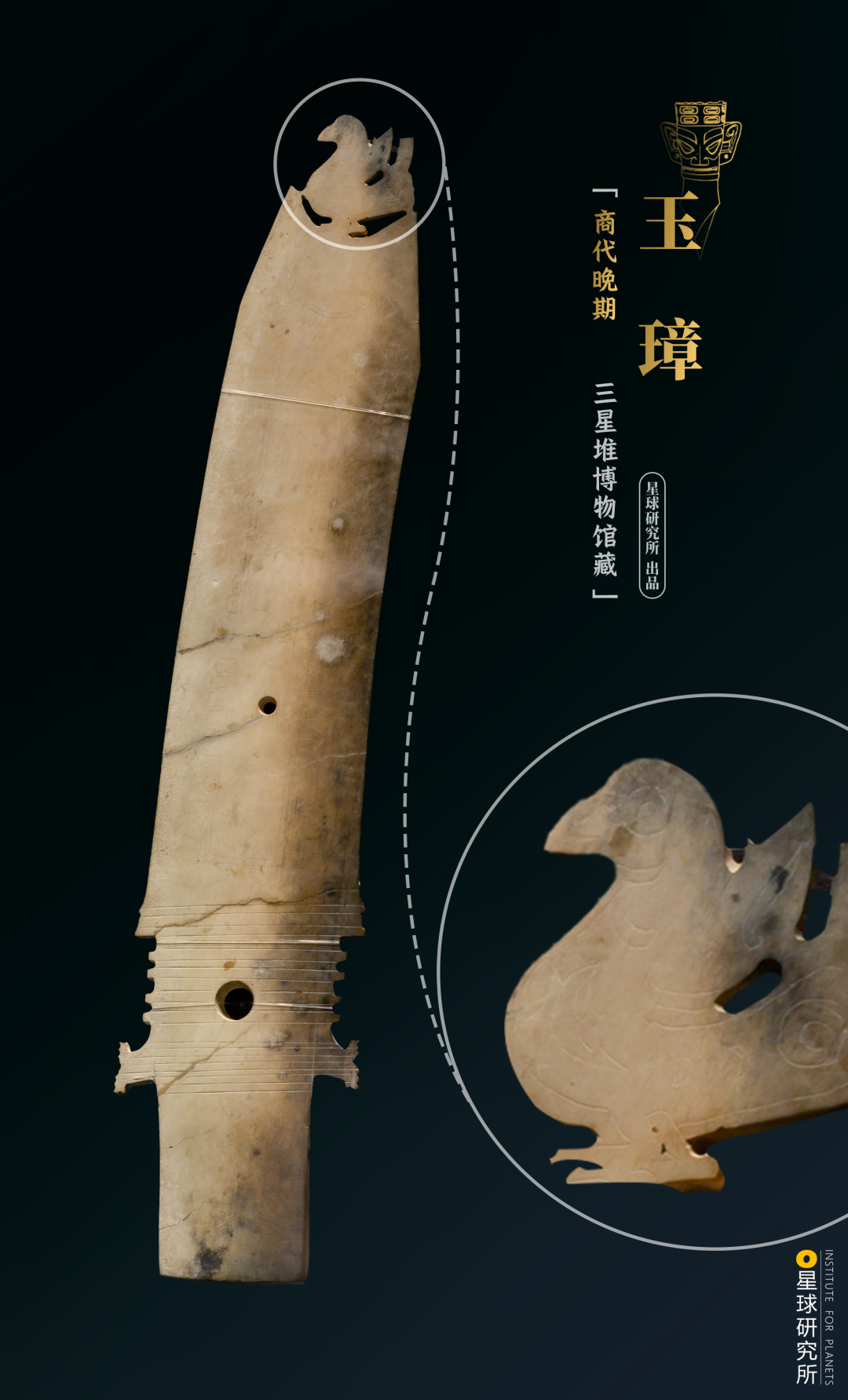
Pure jade was polished into ritual vessels—instruments for communing with the gods. For only the purest of forces could truly “move” the spirits.
(The Zhang—a blade-like jade tablet—was one of the significant ritual vessels of antiquity; Photography by Zhang Yan, Illustration by Feng Yizhuo / Planet Institute)
 “Sanxingdui”
The other universe—the realm where the gods reside— must possess a scale that inspires awe. Vast, immense, colossal—it must be crafted on a truly monumental scale; only in this way can it command sufficient power to declare the might of the deities to the world.
(Some of the bronze artifacts at Sanxingdui are of colossal size, reflecting the fervent religious beliefs of the Sanxingdui people. Photography by @Su Lihuan & Tan Benjian; Graphics by @Wang Shenwen / Planet Institute)
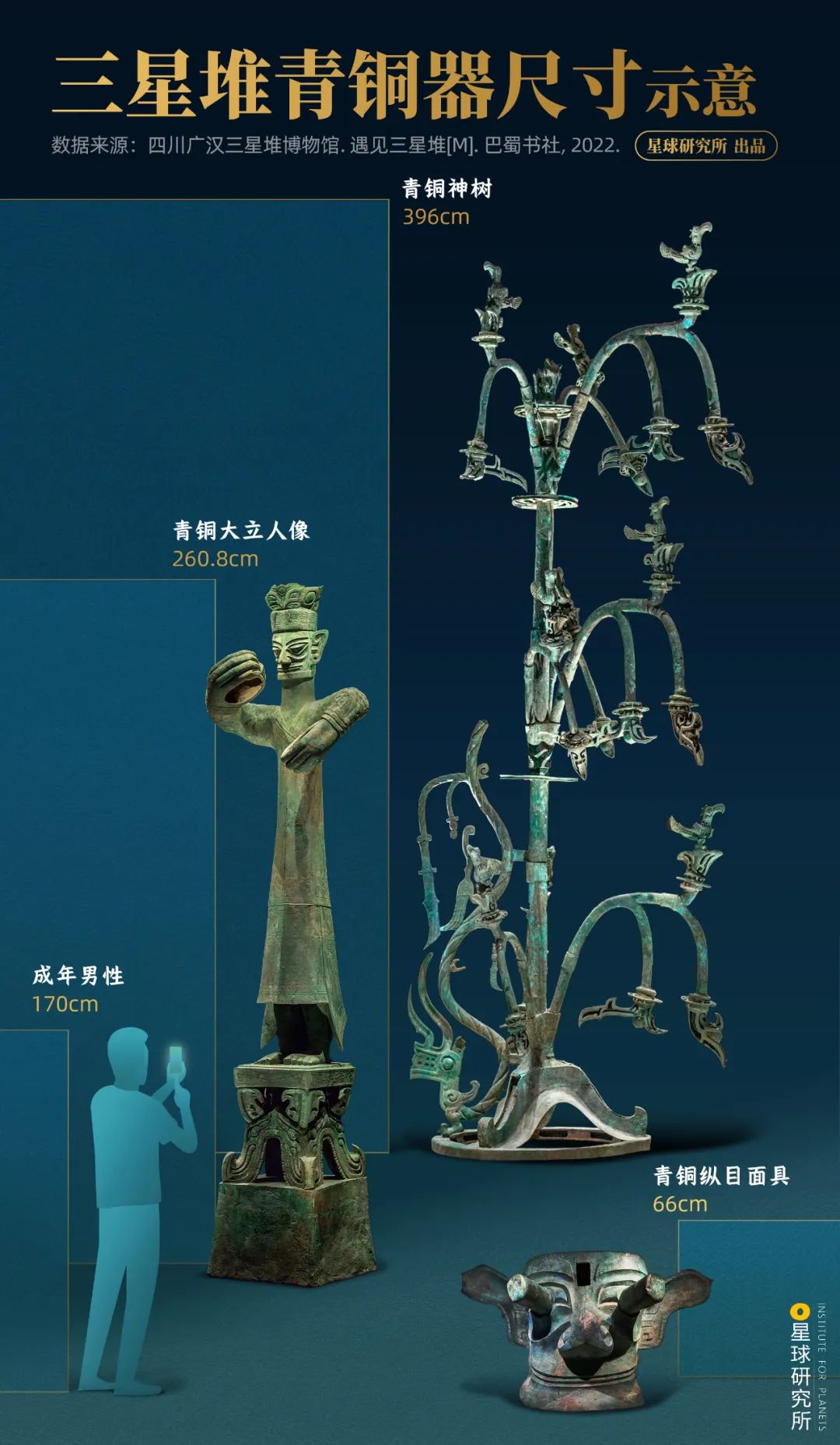
However, not everyone is deemed worthy to converse with this universe— this other realm where the gods dwell. Only those of the highest nobility are permitted to commune with it.
A rigidly hierarchical ruling elite
held absolute sway over both statecraft and religion.
They served simultaneously as the kingdom’s rulers,
as a tightly knit priestly order,
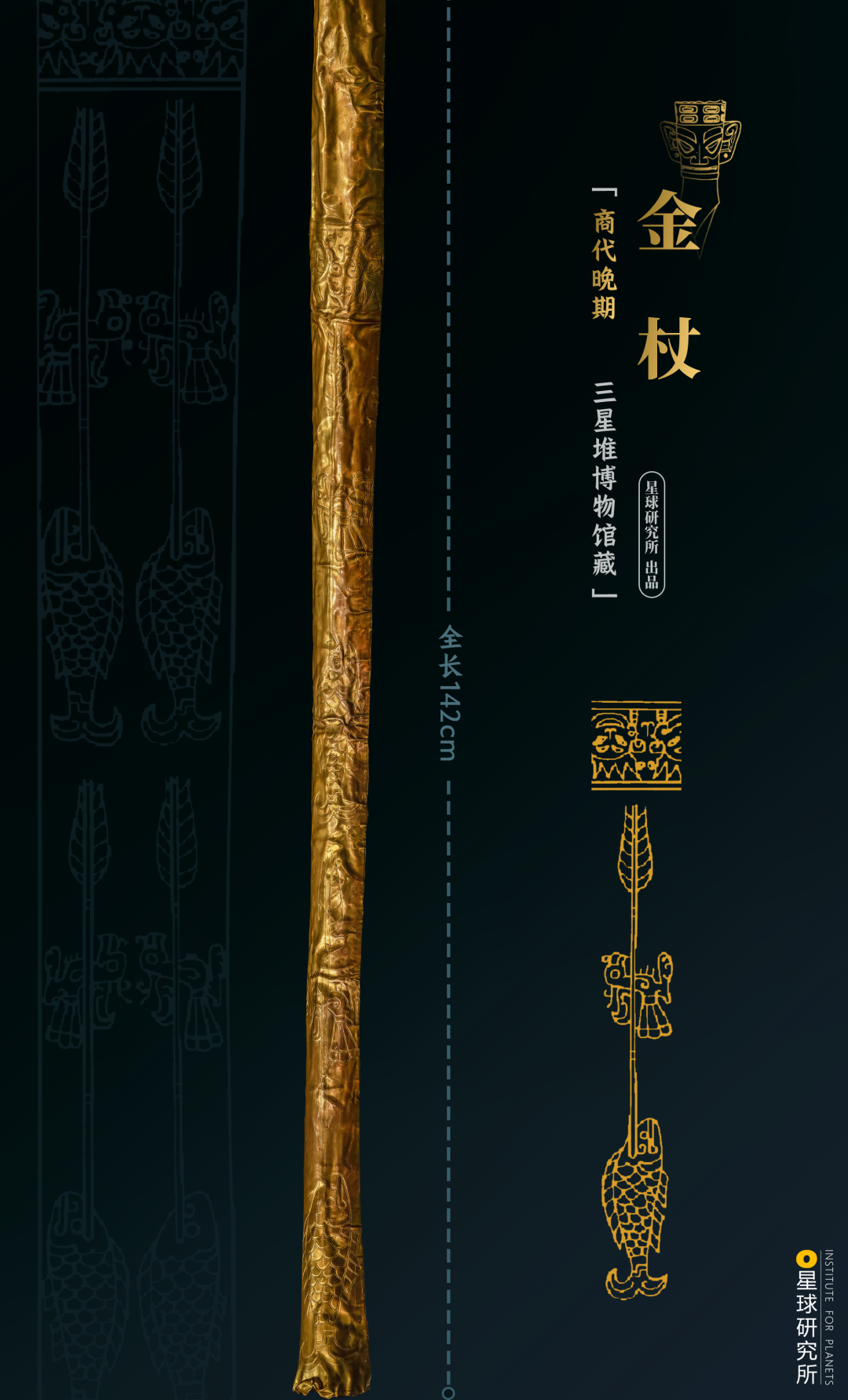
and—above all—as the very spokespersons for the gods.
(The fish-and-bird motifs adorning the Golden Staff may represent “Yufu” [Fish-Cormorant], the legendary ruler of the Sanxingdui Kingdom. Photography by @Zhang Yan; Graphics by @Feng Yizhuo / Planet Institute)
Beneath the supreme ruler
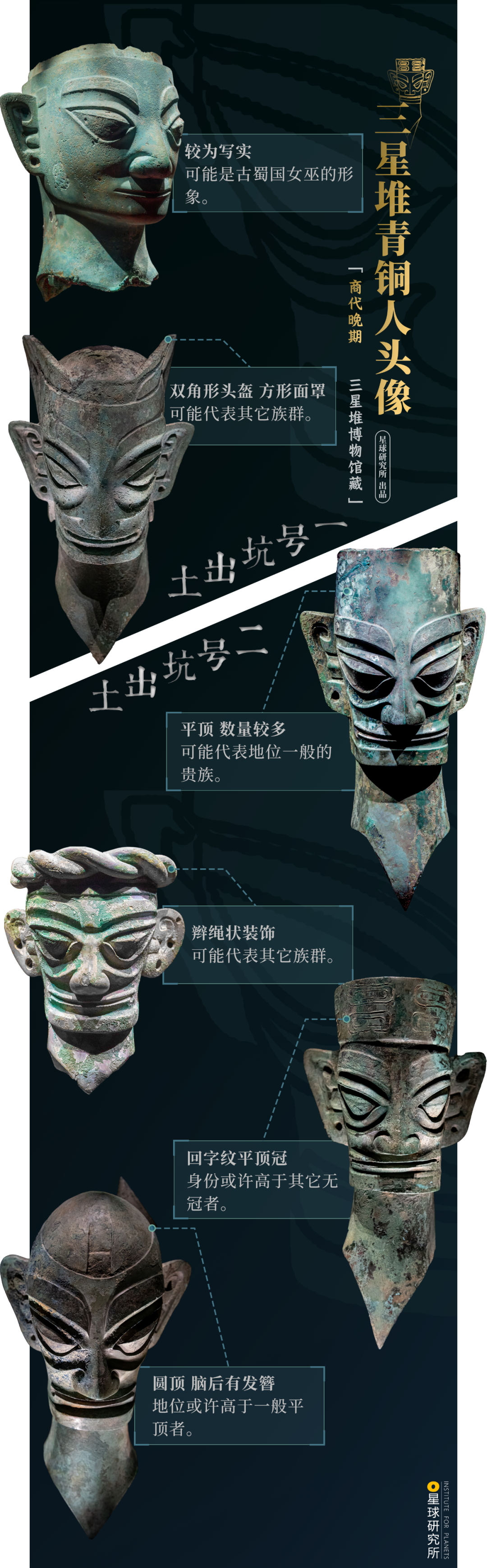
stood a multitude of noble classes; their attire varied widely, seemingly signifying distinct factions or allegiances.
(The differences in their hairstyles and headwear may symbolize varying social ranks or tribal affiliations. Photography by @Zhang Yan, Sun Yi, & Bao Haolin; Graphics by @Feng Yizhuo / Planet Institute)
 “Sanxingdui”
To unlock another universe, a grand and unique sacrificial ceremony is naturally required.
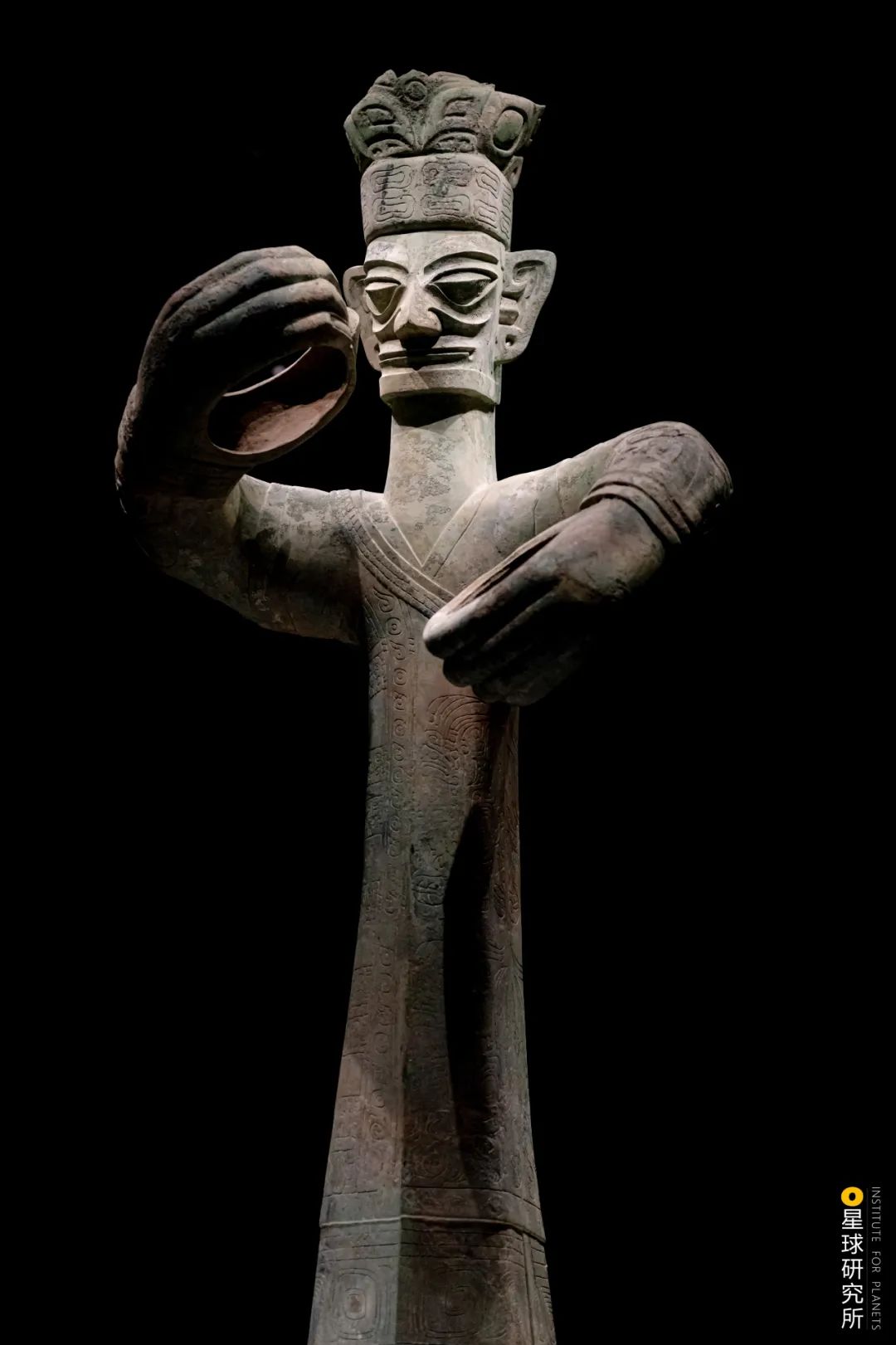
Let us imagine this magnificent scene: at the forefront stands the supreme ruler of Sanxingdui—crowned, clad in resplendent robes, and holding aloft an ivory tusk—leading a multitude of shamans in an act of worship.
(This figure is the largest bronze human statue in the world from that era; it likely originally held an ivory tusk in its hands and represents the Sanxingdui leader who embodied the combined identities of deity, shaman, and king. Photographer: @Bao Haolin)
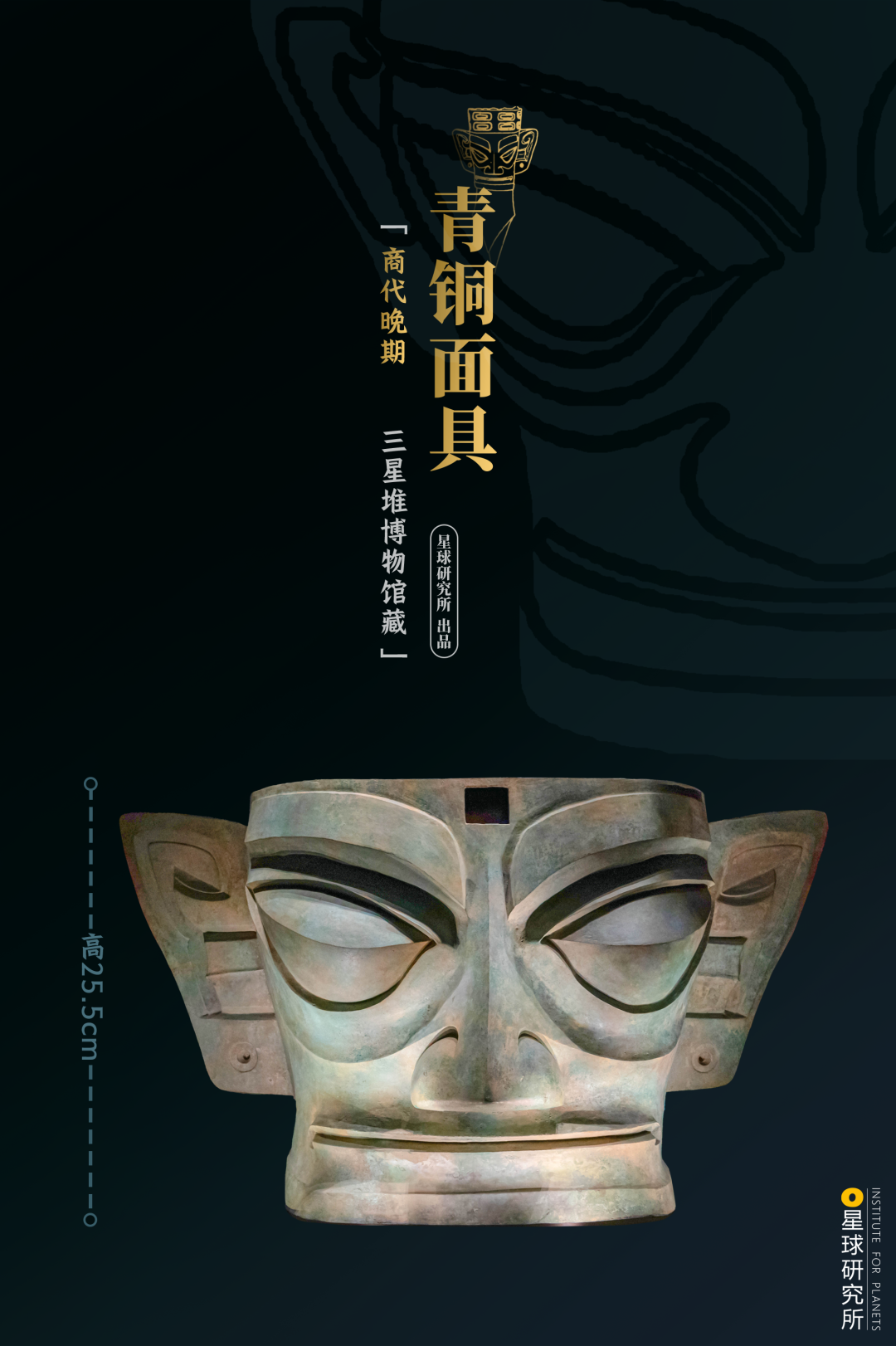
The priests don specially crafted masks. In this moment, they are no longer mere mortals, but have transformed into intermediaries bridging the realm of humans and the realm of gods.
(Bronze Human Mask. Photographer: @Bao Haolin; Graphics: @Feng Yizhuo / Planet Institute)
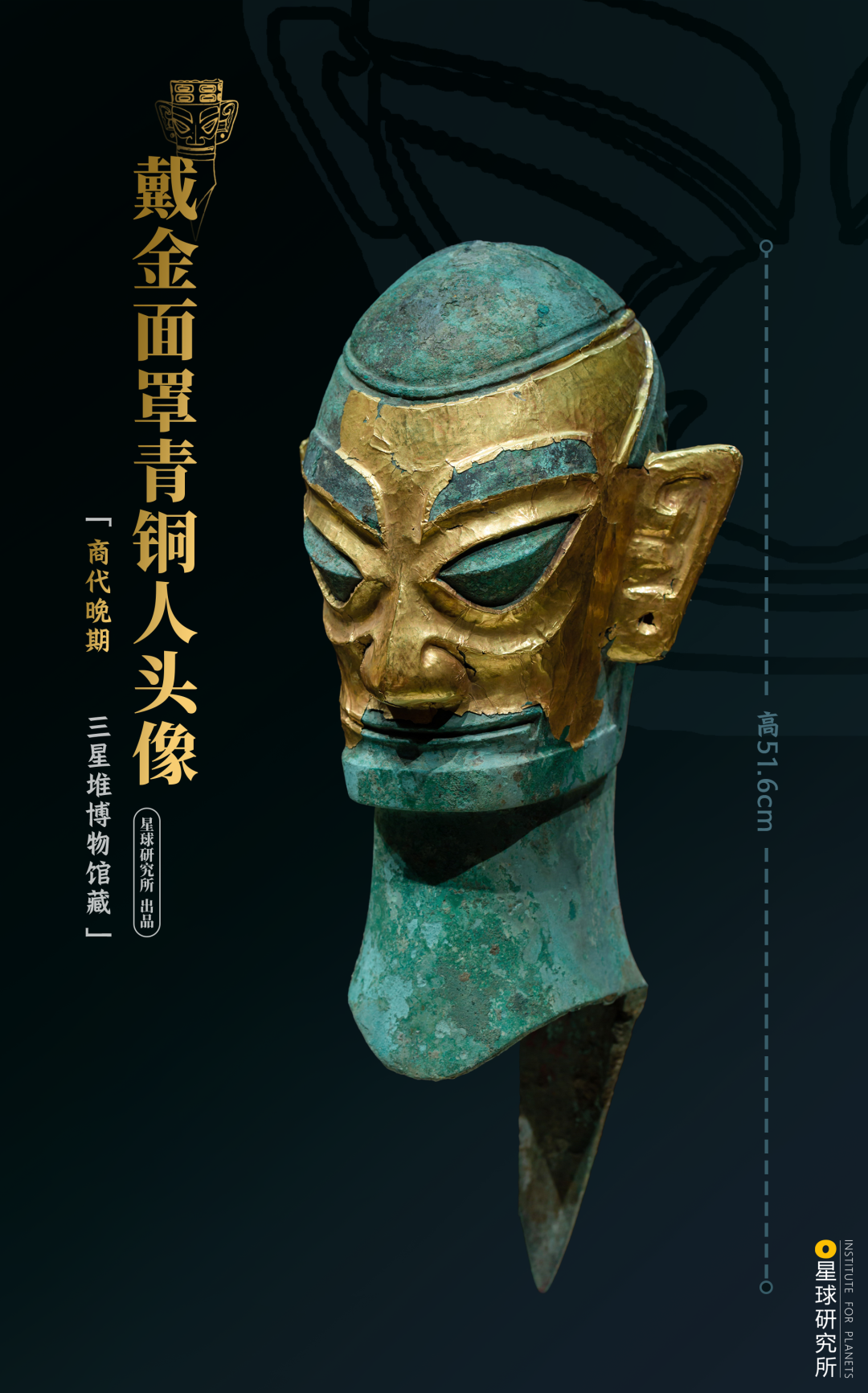
High-ranking priests,
Moreover, have their faces covered in gold.
Perhaps, with the aid of gold,
The communication might flow even more freely.
(Bronze Human Head with Gold Mask. Photographer: @Zhang Yan; Graphics: @Feng Yizhuo / Planet Institute)
 (Sanxingdui)
The methods used to offer sacrifices
to the deities varied greatly.
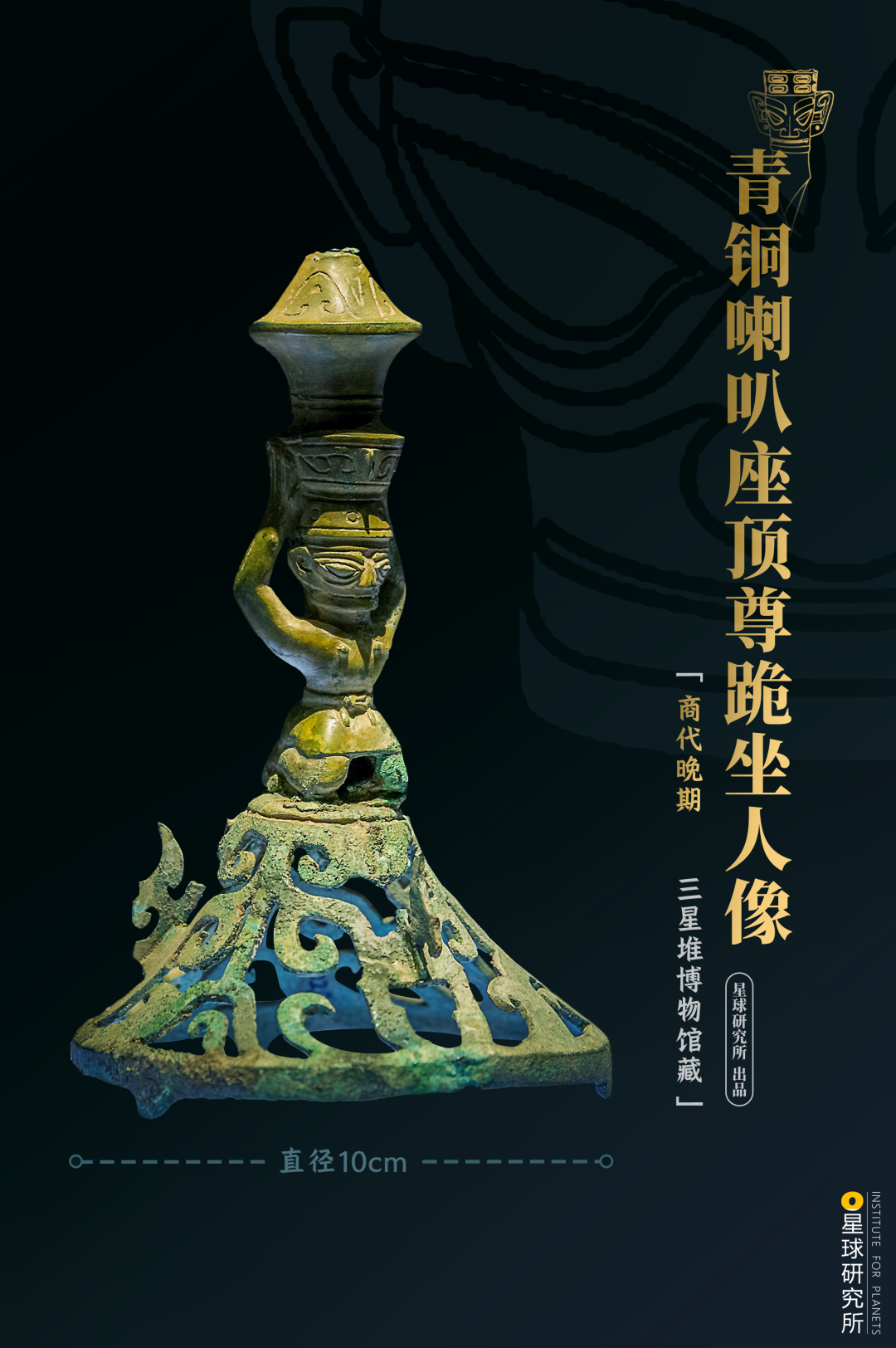
Some priests
knelt upon altars—symbols of sacred mountains—
holding bronze zun vessels high above their heads.
(Bronze Kneeling Figure with Trumpet-Shaped Pedestal and Vessel atop Head; Photo: @Tan Benjian; Graphics: @Feng Yizhuo / Planet Research Institute)
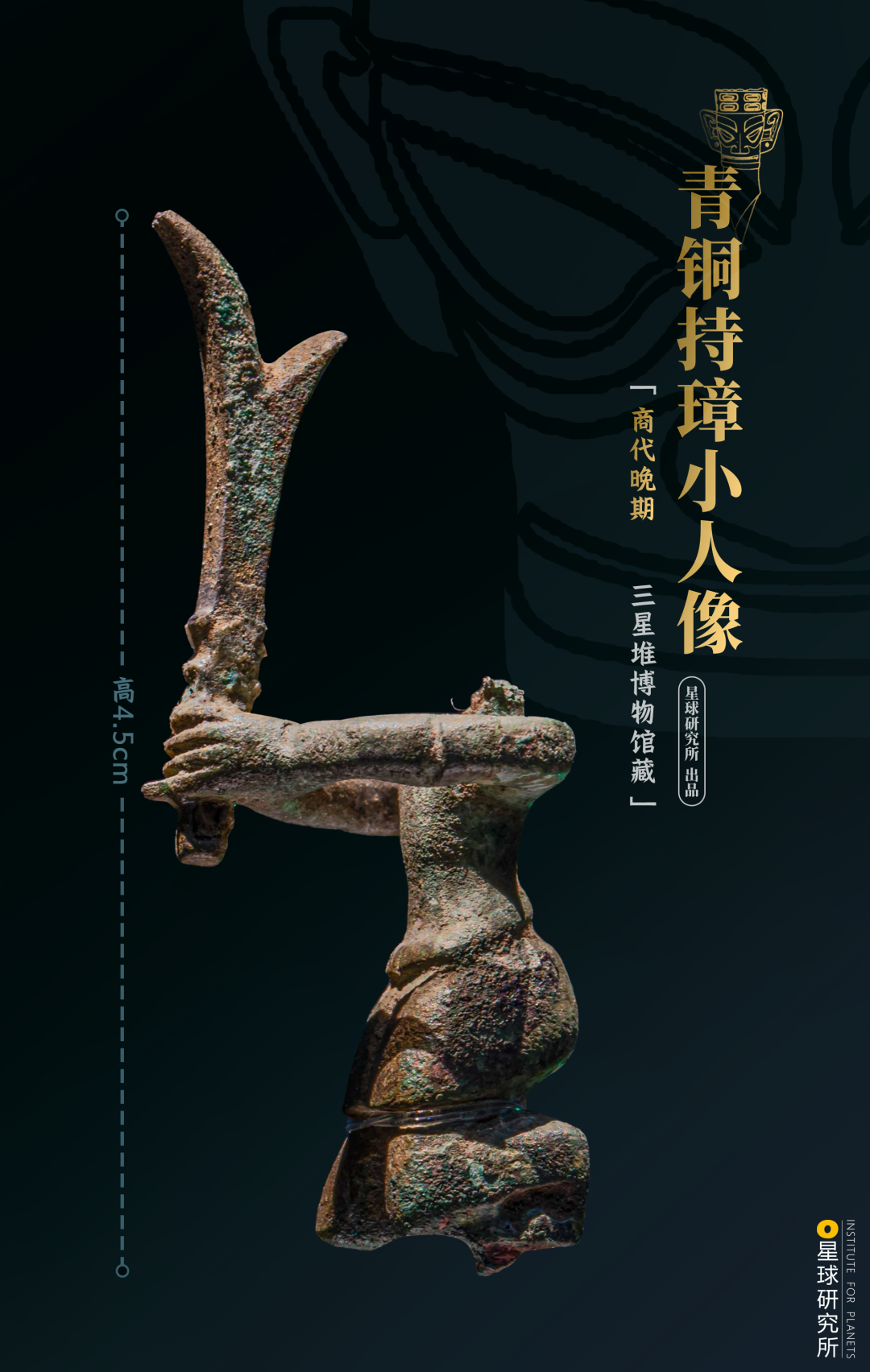
Other priests
grasped jade zhang scepters in both hands,
holding them level with their chests in an act of deep reverence.
(Small Bronze Figure Holding a Zhang Scepter; Photo: @Zhang Yan; Graphics: @Feng Yizhuo / Planet Research Institute)
Still other priests
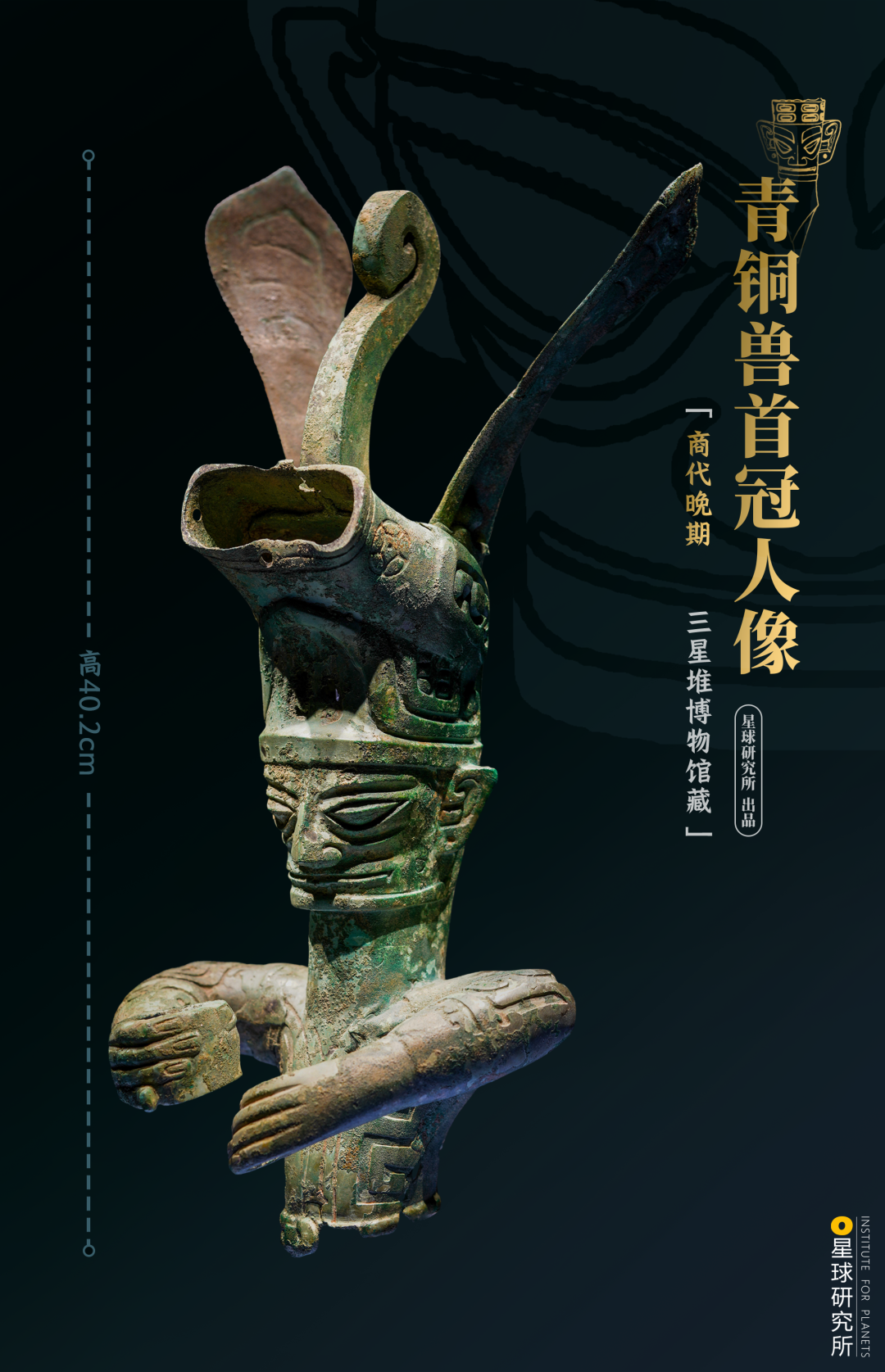
donned bizarre animal-head crowns
to present precious ivory to the deities.
(Bronze Figure with Animal-Head Crown—note that the hand gestures mirror those of the “Great Standing Figure,” suggesting this figure, too, may have originally held ivory; Photo: @Zhang Yan; Graphics: @Feng Yizhuo / Planet Research Institute)
 “Sanxingdui”
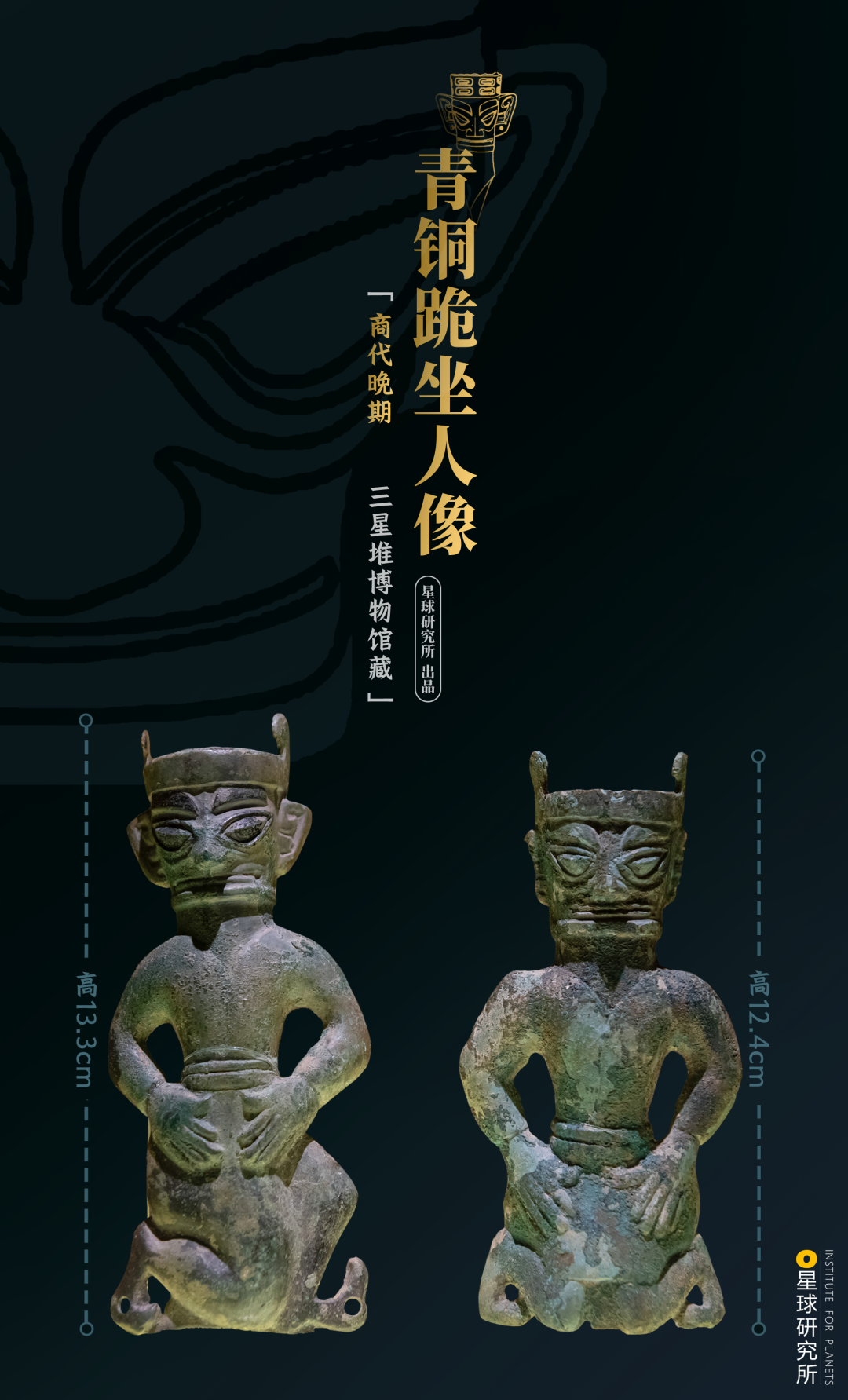
The remaining priests
knelt in a seated posture around the sacrificial altar,
offering their prayers to the deities.
(Bronze Kneeling Figure; Photography: @Bao Haolin; Illustration: @Feng Yizhuo / Planet Institute)
Whether standing or kneeling, singing or dancing,
atop the man-made sacred platform,
they presented their offerings to the spirits,
seeking to appease the deities
and yearning to bask in their eternal protection.
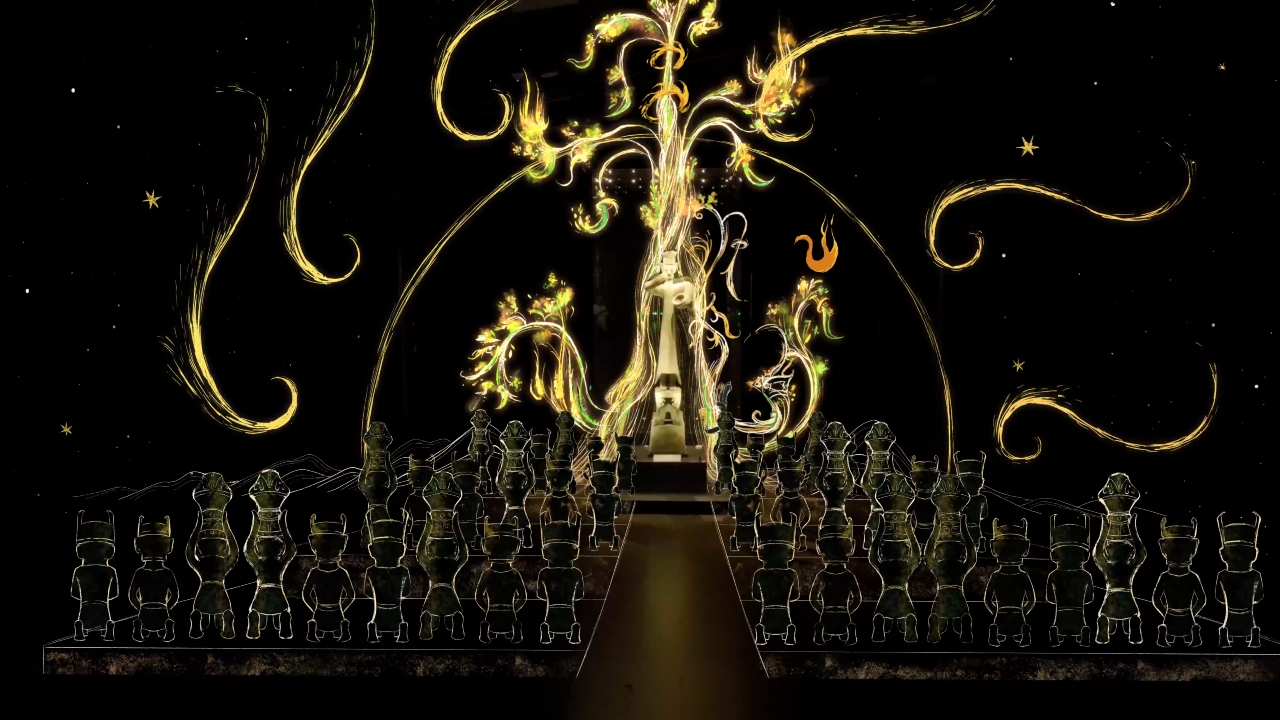
(Click to watch: An artistic reimagining of a Sanxingdui sacrificial ceremony; Illustration: @Xiao Tong & Song Zhipeng / Planet Institute)
But could the hymns that the ancient Shu people sang with all their might truly be heard by the gods?